

The levelized cost of energy (LCOE)
The levelized cost of energy (LCOE), also referred to as the levelized cost of electricity or the levelized energy cost (LEC), is a measurement used to assess and compare alternative methods of energy production. The LCOE of an energy-generating asset can be thought of as the average total cost of building and operating the asset per unit of total electricity generated over an assumed lifetime.
Alternatively, the levelized cost of energy can be thought of as the average minimum price at which the electricity generated by the asset is required to be sold in order to offset the total costs of production over its lifetime. Calculating the LCOE is related to the concept of assessing a project’s net present value. Similar to using NPV, the LCOE can be used to determine whether a project will be a worthwhile venture.
- The LCOE is a fundamental calculation used in the preliminary assessment of an energy-producing project.
- The LCOE can be used to determine whether to move forward with a project or as a means to compare different energy-producing projects.
- The formula to calculate the LCOE is (Present Value of Total Cost Over the Lifetime)/(Present Value of All Electricity Generated Over the Lifetime).
Formula
The total cost of a system (brought back to present value: NPV) divided by the total amount of energy it produces is called Levelized Cost of Electricity or (LCOE). LCOE is measured in units of Rs /Watt or Rs / Kilowatt.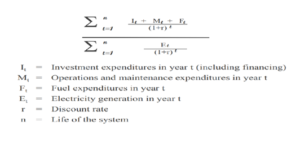
Significance
The levelized cost of energy is a very important metric in determining whether or not to move forward with a project. The LCOE will determine if a project will break even or be profitable. If not, then the firm will not go ahead with building the power-generating asset and will look for an alternative. Using the LCOE to assess a project is one of the first fundamental steps taken in analyzing projects of this nature.
The LCOE is also an important calculation to allow financial analysts to compare different energy-producing technologies, such as wind, solar, and nuclear power sources. It allows for these comparisons regardless of unequal life spans, differing capital costs, size of the projects, and the differing risk associated with each project. This is because the LCOE reflects a per-unit cost of electricity generated, and the risk of each project is an implication of the specific discount rate used for each power-generating asset.